Six specification decisions and a 10-point pre-order checklist — everything you need before ordering on any industrial project.
6
Key Factors
10
Checklist Items
IEC
60309 Certified
For contractors, selecting industrial plugs is not only a purchasing decision. It affects site safety, installation quality, maintenance cost and project reliability. The right specification, documented correctly, also protects the contractor in any future compliance review.
Six Critical Selection Factors
01
Current Rating
Always match to peak equipment load — 16A · 32A · 63A · 125A. Undersizing creates thermal runaway. IEC colour coding prevents mix-up: blue for single-phase, red for three-phase.
02
Voltage and Phase Configuration
Confirm single-phase (230V) or three-phase (400V). Verify neutral requirement. Earth is mandatory in all industrial installations. Wrong phase selection creates physically incompatible connections.
03
IP Protection Class
Use IP44 for dry protected indoor areas. Specify IP67 as the professional minimum for outdoor, construction or wet environments. Do not downgrade IP class to save cost — the liability and replacement cost always exceeds the saving.
04
Mechanical Strength and IK Rating
Construction sites and factory floors demand impact-resistant thermoplastic housings. Check the IK rating alongside IP — a product can be IP67 but mechanically fragile. For high-traffic areas, specify IK08 or higher.
05
IEC 60309 Dimensional Compatibility
IEC 60309-2:2021 defines pin and contact-tube dimensional requirements. When specifying a large project, standardise on a single IEC-compatible product family — this guarantees interoperability between plug, socket and coupler, even from future replacement stock.
06
EU Safety Compliance and Documentation
All low-voltage electrical equipment placed on EU markets must comply with Directive 2014/35/EU. Always verify CE marking and request a full Declaration of Conformity. For handover documentation, this paperwork is non-negotiable.
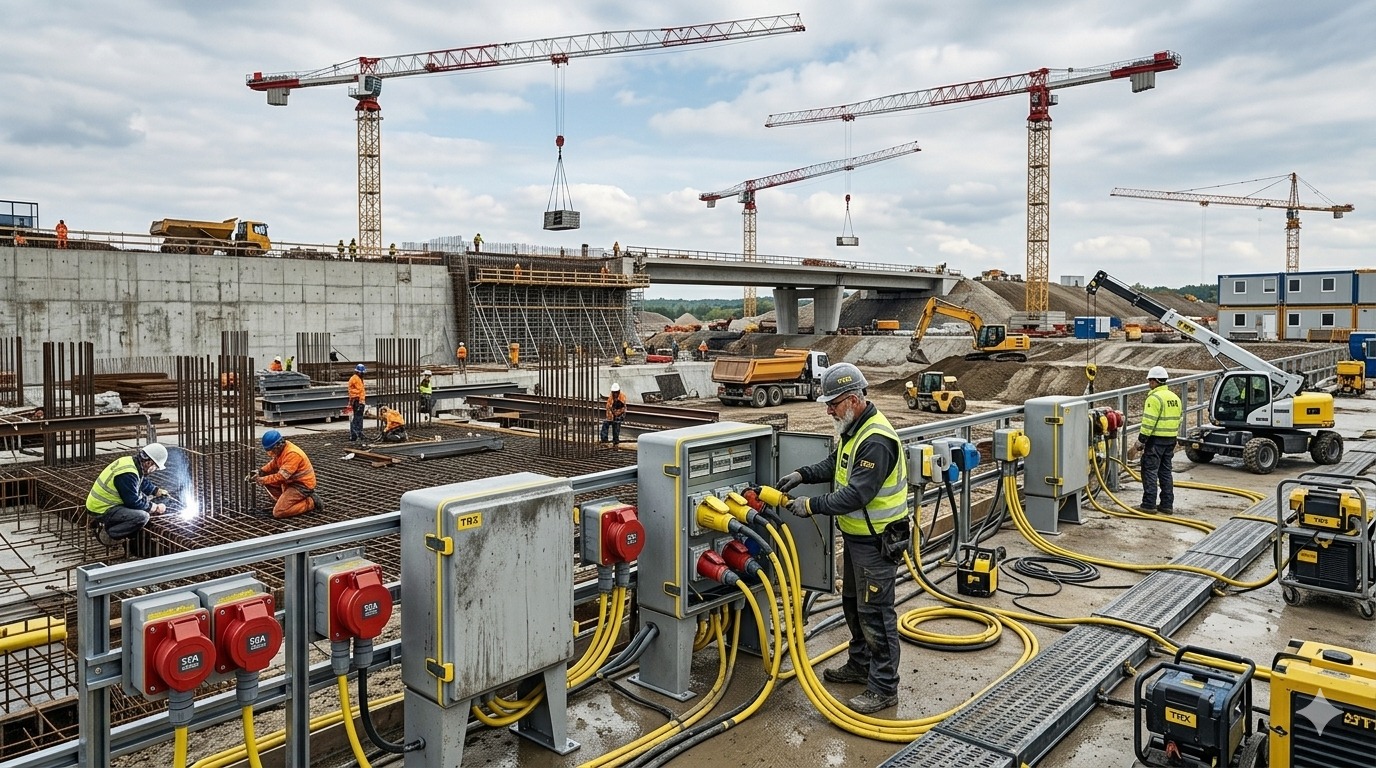
Professional TRX power distribution on a large construction project — multi-outlet IP67 distribution boards with red and blue CEE connectors, 16A to 63A.
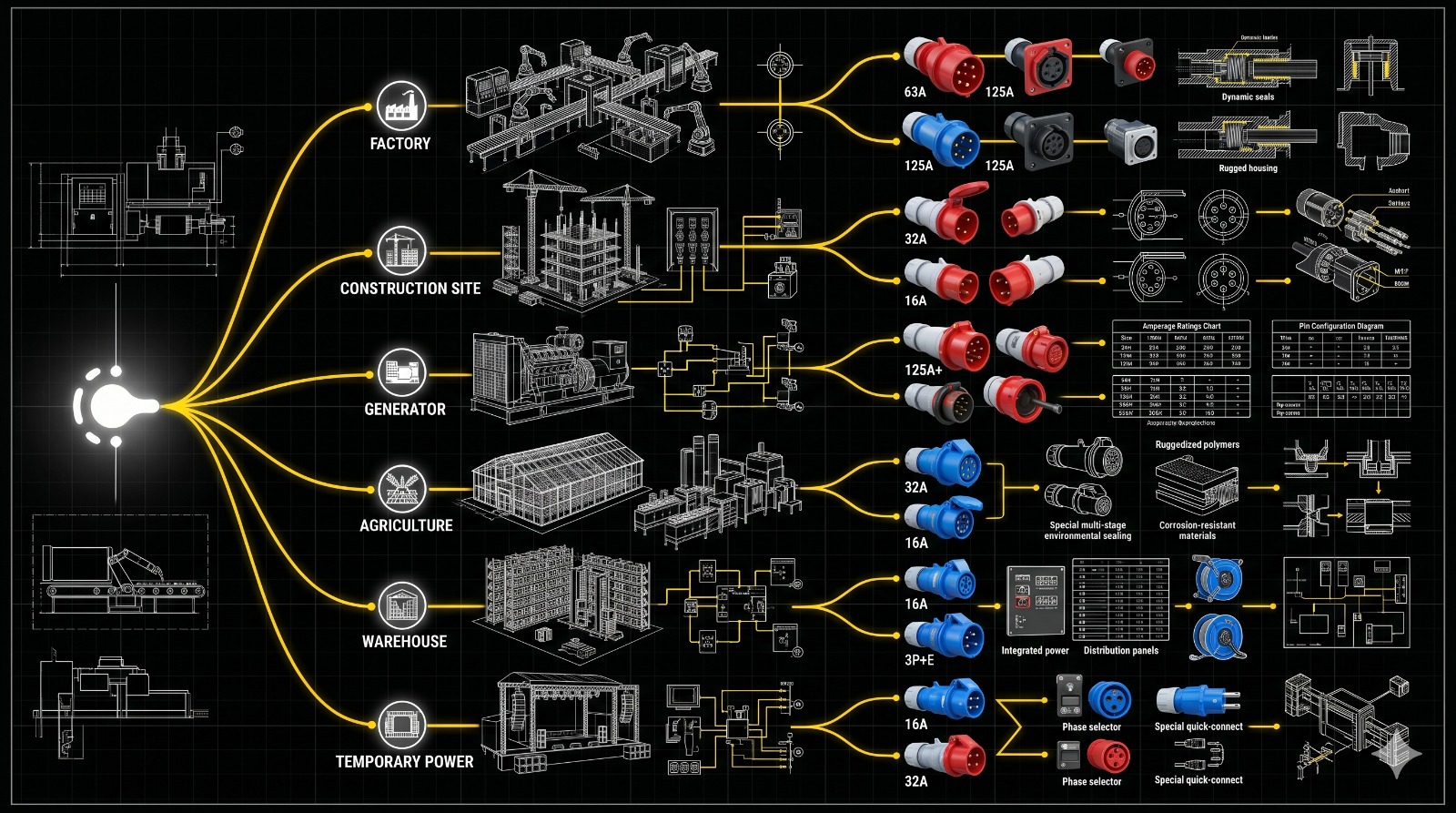
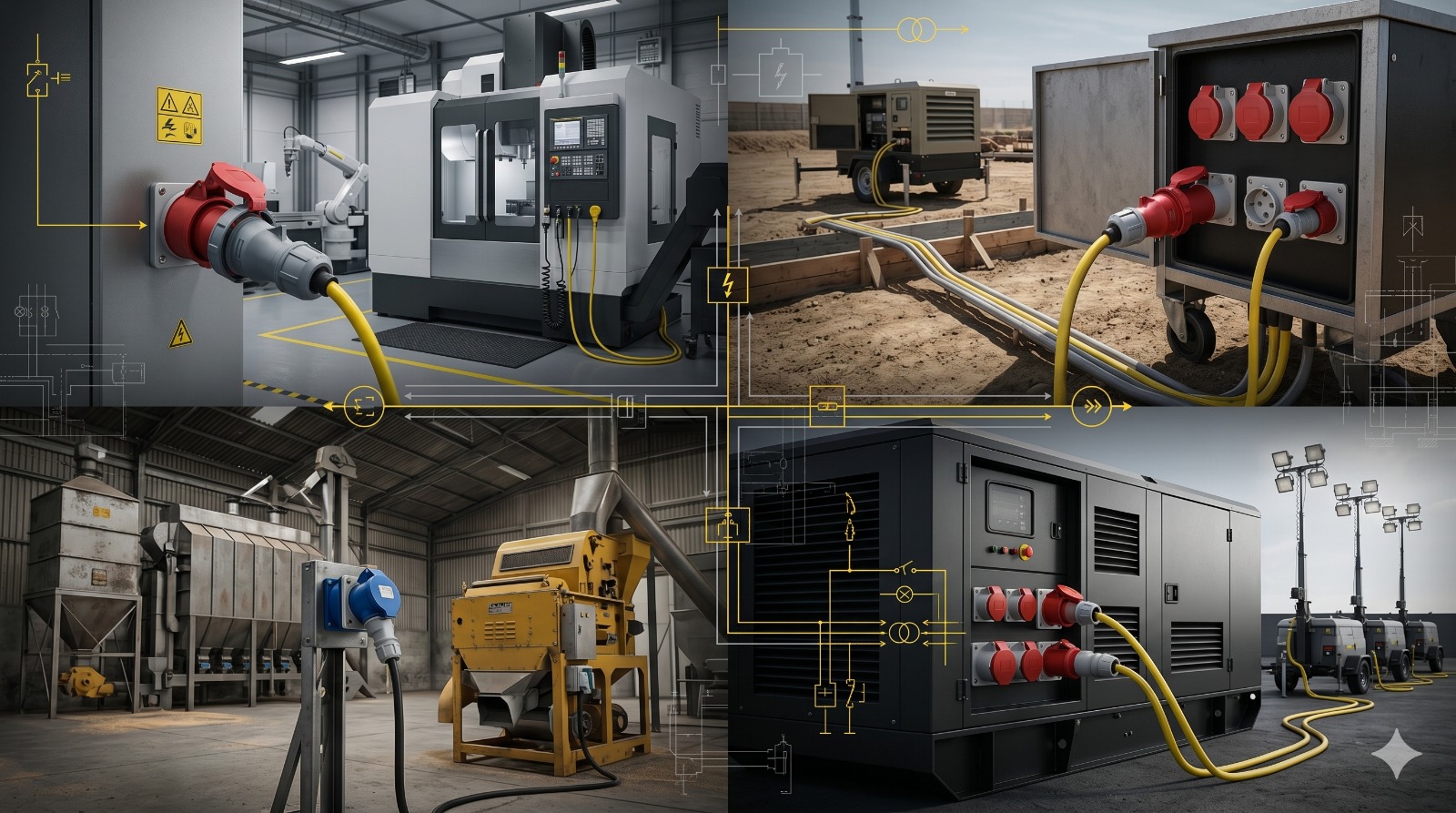
TRX application coverage: from 16A agriculture to 125A+ factory installations — one certified product family across all industrial sectors.
Pre-Order Checklist
Confirm all items before ordering
✓
Current rating confirmed to load
✓
Voltage and phase verified
✓
Pole configuration (2P+E / 3P+E / 3P+N+E)
✓
IP rating matched to environment
✓
IK rating confirmed for site conditions
✓
Cable cross-section and gland size
✓
CE marking and IEC 60309 certification
✓
Declaration of Conformity requested
✓
Quantity confirmed + spare buffer
✓
Product family IEC 60309-2 compatibility
TRX Recommendation
Standardise your connector range once. Benefit on every project.
Contractors who standardise TRX industrial connectors by application type report fewer installation errors, faster replacements and measurably better project efficiency. The TRX range covers 16A to 125A, IP44 to IP67, all IEC 60309 certified and CE marked.
IP44 vs IP67 Industrial Sockets: Which One Should You Choose?
IP Rating Guide
IP44 vs IP67 Industrial Sockets
The difference between these two ratings can determine the safety and reliability of your entire installation.
IP44
Indoor
IP67
Outdoor / Harsh
The IP (Ingress Protection) rating is the single most critical specification when selecting sockets for any environment beyond a clean, dry indoor space. Defined by IEC 60529, the IP code describes how well an enclosure resists solid particles and water — and choosing the wrong class results in product failure, electrical hazards and costly downtime.
How to Read an IP Code
IP X 4
First Digit — Solid Protection
Scale 0–6. Digit 4 = protection against objects ≥ 1 mm. Digit 6 = completely dust-tight — no ingress at all.
IP 4 X
Second Digit — Water Protection
Scale 0–9. Digit 4 = splashing water. Digit 7 = temporary immersion up to 1 metre for 30 minutes.
IP44
Indoor / Protected Outdoor
Protects Against
Solid objects larger than 1 mm
Water splashing from any direction
Immersion · Dust-tight · Jet water
Best For
Indoor workshops · Protected covered areas · Light industrial
Recommended
IP67
Outdoor / Harsh Environments
Protects Against
Complete dust ingress — fully dust-tight
Temporary immersion: 1 m / 30 min
Heavy rain, marine spray, flooding
Best For
Outdoor · Construction · Marine · Agriculture · Wet industrial
TRX IP67 Connector Range
TRX IP67-rated industrial connectors — built without compromise for outdoor, construction and marine environments.
Quick Decision Reference
Environment
IP44
IP67
Dry indoor workshop
YES
Optional
Covered outdoor area
CAUTION
YES
Exposed outdoor installation
NO
YES
Construction site
NO
YES
Marine / Agriculture
NO
YES
TRX Recommendation
When in doubt, specify IP67.
The cost difference between IP44 and IP67 is marginal. The cost of a single failure — product replacement, downtime, safety investigation — far exceeds it. TRX IP67 connectors are engineered for permanent exposure to outdoor, industrial and marine environments.
IEC 60309 Explained: Complete Guide for Industrial Plugs and Sockets
Technical Reference
IEC 60309 Explained
The international standard that governs every industrial plug, socket-outlet and coupler used in professional electrical installations worldwide.
800A
Max Rating
1000V
Max Voltage
IP67
Protection
IEC 60309 is the international standard governing industrial plugs, socket-outlets, appliance inlets and couplers. Issued as IEC 60309-1:2021, it covers accessories rated up to 1,000 V AC/DC, 500 Hz and 800 A for industrial use indoors and outdoors. It is the benchmark for safe, interoperable industrial electrical connections across more than 60 countries.
Why It Matters
The Standard Behind Every Safe Industrial Connection
Industrial connections face heavy use, mechanical stress, humidity, dust and the constant risk of incorrect connection. IEC 60309 standardises dimensions, compatibility and performance — creating a universal interoperable system across all manufacturers and territories.
60+
Countries adopt IEC 60309 as national standard
4
Standard current ratings: 16A · 32A · 63A · 125A
100%
Keyed design prevents incorrect connection by geometry
Common Applications
Manufacturing
Factory floors and assembly line power distribution
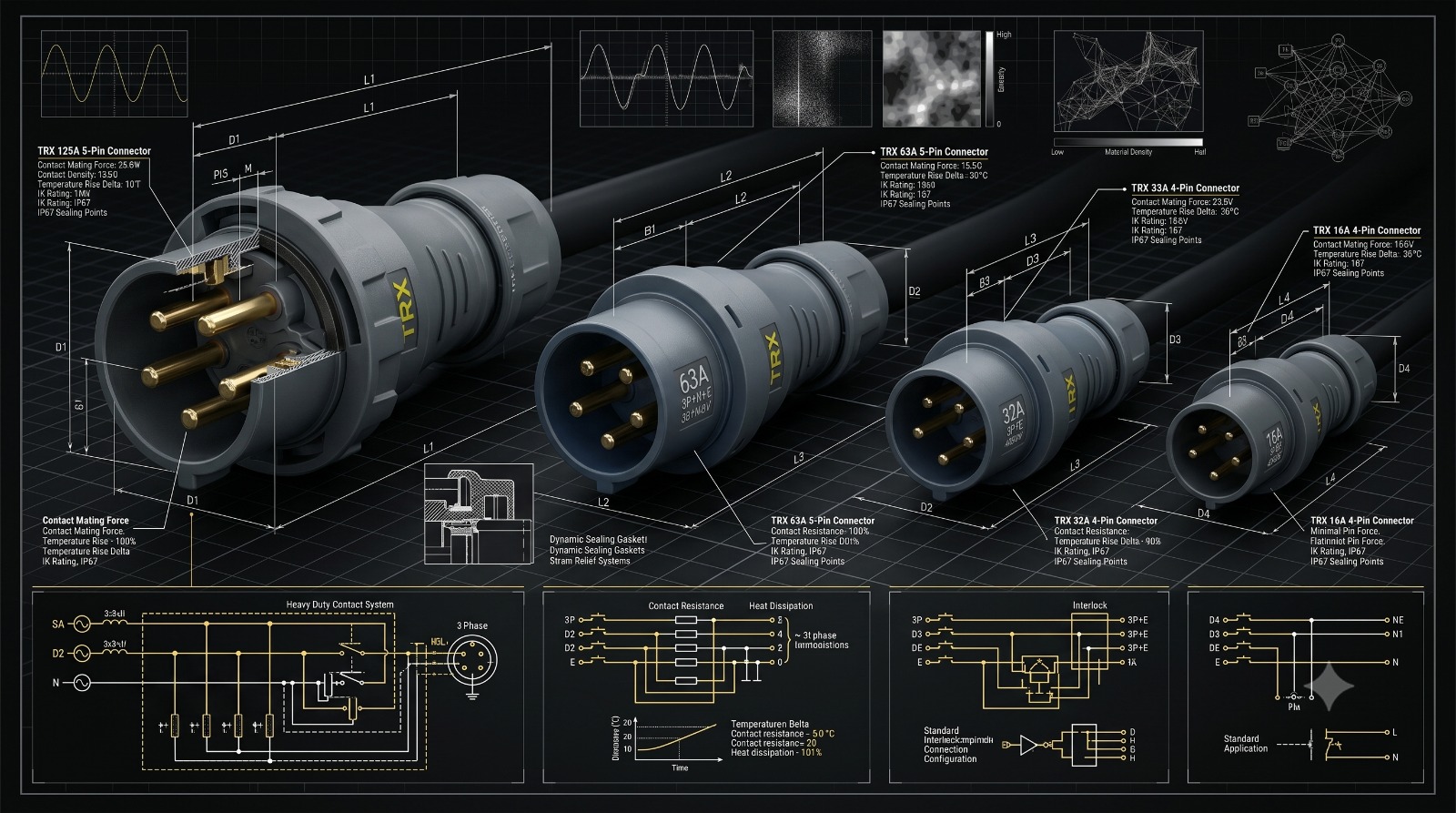
TRX IEC 60309-compliant connector range — 16A to 125A — engineered and tested for demanding industrial environments worldwide.
TRX Professional Recommendation
Specify by environment first — current rating second.
A 63A plug in the wrong IP class is more dangerous than a 32A plug correctly specified. TRX recommends basing product selection on installation environment, IP class and mechanical resistance before arriving at current rating.
Contractor’s Complete Guide to IEC Industrial Plug Standards
CONTRACTOR GUIDE
Contractor’s Complete Guide to IEC Industrial Plug Standards
From reading the specification to signing off the compliance file — everything the working electrical contractor needs to know about IEC 60309 industrial connector installation.
►Industrial Electrical 11 min read TRX Editorial Team
Reading Specifications
Electrical specifications for industrial installations typically identify IEC 60309 products through a structured code that encodes all the key parameters. Understanding how to read this code quickly and accurately is a fundamental skill for any contractor working on industrial projects. A typical specification reference might appear as: “IEC 60309-2, 32 A, 3P+N+E, 400 V, IP67, 6h” — each element carrying a specific meaning.
The “6h” at the end refers to the keying position of the earthing contact — a clock-face notation that ensures only products with identical keying will mate. The earthing contact position varies with voltage and frequency to prevent cross-connection between circuits of different voltage. For 400 V 50 Hz three-phase circuits, 6h is the standard position corresponding to red-coloured connectors. For 230 V 50 Hz single-phase, 6h is also standard, corresponding to blue. The 4h position corresponds to yellow 110 V RLV connectors.
Always verify that both the plug and the socket carry the same keying notation before installation. A mismatch will prevent engagement, but discovering this during installation rather than at the ordering stage causes costly delays.
Site Survey Checklist
Before specifying or ordering any IEC 60309 products for a site installation, complete a structured site survey. The following checklist covers the information required to make correct product selections.
Supply Voltage and Frequency
Confirm from the distribution board — do not assume. Note whether any areas are on RLV (110 V) or specialist supply.
Maximum Load Current
Identify all connected loads from equipment schedules. Calculate diversity-adjusted maximum demand for each circuit.
Environmental Classification
Photograph each installation location. Note exposure to rain, dust, chemicals, UV, temperature extremes, mechanical impact and flooding risk.
Usage Frequency
Will the connection be permanent, monthly, daily or multiple times per day? High cycle-count applications need heavy-duty locking rings.
Specifying the Right Socket
With site survey data in hand, complete the connector specification using the five-step method: current rating, pole configuration, voltage/keying, IP class, material specification. Document each decision and its justification in the project technical file — this documentation is required for compliance with the Low Voltage Directive and will be needed for any future inspection, insurance claim or incident investigation.
Installation Standards: IEC and EN Requirements
IEC 60309-1 covers the general requirements for plugs, socket-outlets, vehicle connectors and vehicle inlets. IEC 60309-2 covers the dimensional requirements for interchangeability for pin-and-sleeve devices. Both parts are adopted identically as EN 60309-1 and EN 60309-2 in Europe. Installation must also comply with IEC 60364 (Electrical installations of buildings) and relevant national amendments — BS 7671 in the UK, VDE 0100 in Germany, CEI 64-8 in Italy.
TECHNICAL SPECIFICATIONS
TRX product technical specification sheets covering all ratings, pole configurations and IP classes — available for download or on request.
Testing Protocol
Before energisation, every new IEC 60309 installation must be tested to verify electrical integrity. The minimum test sequence for a new installation includes: continuity of protective earthing conductors (maximum 0.05 Ω to any accessible metalwork); insulation resistance (minimum 1 MΩ at 500 V DC between live conductors and earth); polarity verification (live connected to brass centre pin in single-phase connectors); and RCD (residual current device) operation test where RCDs are fitted.
For 63 A and 125 A installations, a load test at rated current for a minimum of one hour is recommended to verify contact temperature rise. Contact resistance should be measured at full load current using a calibrated milliohm meter — values above 0.5 mΩ indicate inadequate contact pressure and require investigation before the installation is commissioned.
IEC 60309 PRODUCT RANGE
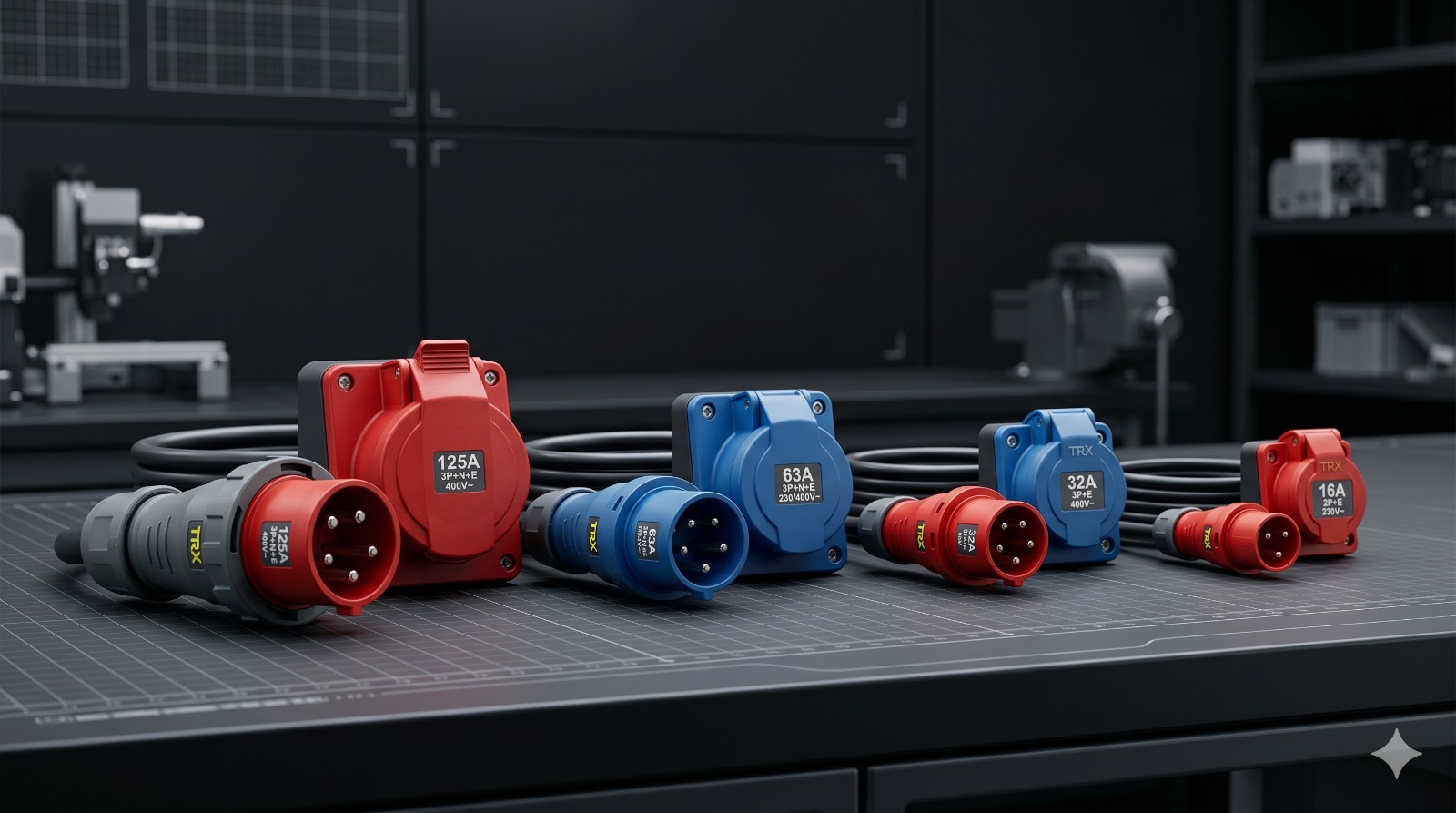
TRX red (400 V three-phase) and blue (230 V single-phase) connectors — the two most commonly specified IEC 60309 variants in European industrial installations.
Commissioning Sign-Off
Commissioning sign-off requires completion of all test documentation, confirmation that all products are installed per manufacturer instructions, verification that all CE documentation is in the project file, and client handover of the as-built drawings, test certificates and product data sheets. In the UK, this requires completion of an Electrical Installation Certificate (EIC) or Minor Works Certificate as appropriate. In Italy, the Dichiarazione di Conformita (DOC) must be issued within 30 days of completion.
The Compliance File
A complete compliance file for an IEC 60309 installation should contain: specification documents with design justifications; product Declarations of Conformity (DoC) for all IEC 60309 products installed; test certificates with dated and signed test results; as-built drawings showing socket locations, circuit references and cable routes; and the installer’s qualifications or accreditation certificates.
This file must be retained by the client for the life of the installation. In the event of an insurance claim, accident investigation or regulatory inspection, the compliance file is the primary evidence that the installation was designed, specified and installed correctly. An incomplete or missing compliance file substantially increases the contractor’s liability exposure.
When to Upgrade an Existing Installation
Existing IEC 60309 installations should be reviewed for upgrade when: load has increased beyond 80% of the connector current rating; the installation environment has changed (new washdown area, outdoor conversion); products approaching end of service life show cracked bodies, degraded seals or elevated contact resistance; regulatory requirements have changed for the industry sector; or the existing products are uncertified and CE documentation cannot be produced. TRX offers a free technical audit service for existing installations — contact the technical team via trx-elettrico.it/.
TRX RECOMMENDATION
Trusted by Contractors Across Italy and Europe
TRX products come with full CE documentation, IMQ certification and technical support from our Italian engineering team. Specify with confidence — your compliance file is covered.
Waterproof Outdoor Electrical Installations: TRX Field Guide
FIELD GUIDE
Waterproof Outdoor Electrical Installations: TRX Field Guide
Outdoor industrial power infrastructure demands a different approach to specification, installation and maintenance. Here is the complete field guide from TRX engineers.
►Industrial Electrical 9 min read TRX Editorial Team
Why Outdoor Is Different
Indoor industrial electrical installations operate in a largely controlled environment — temperature is relatively stable, contamination is manageable, and maintenance access is straightforward. Outdoor installations face a fundamentally different set of challenges: wide temperature cycling, solar UV radiation, rain, frost, wind-driven particulates, chemical exposure and biological growth, all operating simultaneously over an asset life that may span two or three decades.
Products and installation methods adequate for indoor use will often fail rapidly in outdoor environments. The selection of connectors, enclosures, cable management systems and fixings must be made with the worst-case outdoor conditions in mind — not average conditions. A connector that performs adequately in summer sunshine may fail during the first winter storm if the specification was not properly considered.
Threat Matrix for Outdoor Installations
Threat
Primary Damage Mechanism
Mitigation
Rain and flooding
Water ingress to contact area, corrosion, arc tracking
IP67 minimum; drip loops on cables; elevated mounting
Solar UV radiation
Polymer degradation, embrittlement, seal cracking
UV-stabilised PA/PP bodies; replace seals per schedule
Thermal cycling
Differential expansion loosening contacts and seals
Verify rated temperature range; use flexible cable
Dust and airborne particles
Contact contamination, tracking over insulator surfaces
IP6X (dust-tight); periodic contact cleaning
Chemical exposure
Polymer attack, accelerated gasket degradation
Specify chemical-resistant materials; consult TRX
IEC 60309 Products for Outdoor Use
For outdoor IEC 60309 applications, IP67-rated products are the recommended starting specification. The TRX IP67 range covers plugs, socket-outlets (both surface-mounting and panel-mounting), couplers and extension units in all standard pole configurations and current ratings. Key features for outdoor durability include UV-stabilised polyamide body materials rated to UV category F per IEC 60068-2-5, EPDM face gaskets tested across the -25°C to +70°C operating range, and contact bodies of high-tin-bronze alloy to resist corrosion in salt-air environments.
For installations in coastal locations or areas with elevated sulphur content in the atmosphere, specify the TRX coastal-duty version with Ni-plated contact bodies and stainless steel locking ring hardware. For installations where periodic flooding is possible — riverbank sites, temporary event infrastructure, port areas — consider IP68-rated versions tested to depths greater than 1 metre, available on request.
Case Study: The Solar Farm Power Infrastructure
Solar photovoltaic installations represent one of the most demanding outdoor electrical environments. Connectors and enclosures must withstand continuous UV exposure for 25+ years, temperature excursions from -20°C in winter to +60°C at panel surface level in summer, wind-driven rain and dust, and occasional flooding of ground-level cable routes — all while remaining accessible for periodic maintenance under live-circuit conditions.
SOLAR FARM INSTALLATION
TRX IP67 enclosures and IEC 60309 connectors at a photovoltaic installation — engineered for 25-year outdoor service without seal replacement.
A representative large-scale solar installation spanning 50 MW across 120 hectares recently specified TRX IP67 63 A 3P+N+E socket-outlets at each inverter station to allow maintenance vehicles to connect portable equipment without shutting down the AC distribution system. The installation used TRX concrete-mount pedestals with integrated IP67 panel-mount sockets, cable entry ducting with IP67 glands, and stainless steel hardware throughout. Five years post-commissioning, no seal or contact replacements have been required.
Cable Management for Outdoor Installations
The cable assembly is the most vulnerable element of any outdoor electrical installation — and the one most frequently under-specified. For outdoor use, cables must carry the H07RN-F or H07BQ-F designation minimum, confirming resistance to oil, ozone and UV. In direct burial applications, SWA (steel wire armoured) or LSZH-sheathed flex with appropriate duct protection is required.
Cable drip loops must be formed wherever cables enter upward-facing sockets or enclosures — a drip loop is a downward loop in the cable immediately below the connector entry point that ensures rainwater running along the cable surface drips off before reaching the connector rather than tracking into it. This simple technique eliminates one of the most common causes of outdoor connector failure.
INDUSTRIAL PANELS
Properly installed and maintained outdoor industrial electrical infrastructure ensures reliable operation across decades of service life.
Maintenance Protocol
Outdoor IEC 60309 installations should be maintained on a schedule that accounts for the installation environment. In a relatively clean rural or coastal environment, an annual inspection cycle is typically adequate. In high-pollution urban or industrial environments, inspection should occur every six months. In food processing, agricultural or chemical industry applications, quarterly inspection is recommended.
Each inspection should cover: physical condition of plug and socket bodies for cracks and impact damage; condition of face gaskets for compression set, cracking or delamination; operation of shutter mechanism; tightness of cable gland; evidence of water or condensation ingress at the contact face; contact resistance measurement at 32 A and 63 A ratings using a calibrated contact resistance meter; and torque check of mounting fixings.
Common Installation Errors Checklist
No Drip Loop Formed
Rainwater runs along the cable directly into the connector body. Form a downward loop minimum 150 mm below the entry point.
Wrong Cable Gland Size
An oversized gland will not compress adequately on the cable, voiding the IP rating at the entry point. Always use the cable manufacturer’s specified outer diameter.
IP44 Used in Rain-Exposed Location
IP44 is tested against splashing water — not sustained rain, ponding or wind-driven precipitation. Always use IP67 for exposed outdoor locations.
Non-UV-Stabilised Cable
Standard PVC cable sheath degrades and cracks under UV exposure within 3–5 years. Specify H07RN-F or UV-stabilised LSZH cable for outdoor installations.
TRX RECOMMENDATION
Engineered for the Italian Outdoors — and Beyond
TRX outdoor-duty IEC 60309 products are tested to IEC 60529 IP67, UV-F category and -25°C to +70°C operating range. Explore the full outdoor product range and request technical data sheets for specification.