
8 min read
TRX Editorial Team
The IP Code Explained
The Ingress Protection (IP) code is defined by IEC 60529 and consists of the letters “IP” followed by two digits. The first digit (0–6) indicates the level of protection against solid particle ingress. The second digit (0–9) indicates the level of protection against water ingress. A higher number in each position indicates greater protection.
| Digit Position | Value | Protection Against |
|---|---|---|
| First (solid) | 4 | Objects > 1 mm (tools, wires) |
| First (solid) | 5 | Dust-protected (limited ingress) |
| First (solid) | 6 | Dust-tight (no ingress) |
| Second (water) | 4 | Splashing water from any direction |
| Second (water) | 7 | Immersion 1 m depth, 30 min |
| Second (water) | 9K | High-pressure / high-temperature jet |
IP44 Use Cases
IP44 is the standard specification for general industrial indoor use and for outdoor applications where the connector is shielded from direct precipitation — for example, under a loading-bay canopy or inside a locked enclosure. The first digit (4) confirms that objects larger than 1 mm cannot contact live parts, protecting against wire ends, tools and small particles. The second digit (4) confirms that water splashing from any direction will not cause harmful ingress under normal conditions.
IP44 should not be used in environments where water can pool, run along surfaces to the connector, or be directed at the connector by wind-driven rain. For anything beyond sheltered outdoor use, IP67 is the correct starting point.
IP67 Use Cases
IP67 is the workhorse rating for outdoor industrial electrical installations. The first digit (6) means fully dust-tight — no dust particles can enter the enclosure under any conditions. The second digit (7) means the connector can be submerged to 1 metre depth for 30 minutes without harmful water ingress. This covers the vast majority of outdoor weather-exposure scenarios, including heavy rain, flooding, ground-level pooling and spray from adjacent processes.
Common IP67 applications include outdoor festival power distribution, solar farm electrical infrastructure, agricultural irrigation system control, marine dock power pedestals and outdoor food service equipment. TRX’s IP67 range uses moulded silicone gaskets and a precision-machined locking collar to achieve a consistent seal across the full rated temperature range of -25°C to +70°C.
IP69K Use Cases
IP69K is the highest ingress protection classification and requires the connector to withstand a jet of water at 80–100 bar pressure, at a temperature of 80°C, delivered from a nozzle held 10–15 cm away at 0°, 30°, 60° and 90° angles. This test replicates the steam and high-pressure cleaning processes used in dairy processing, pharmaceutical manufacturing, brewing, abattoir operations and commercial vehicle washing facilities. If your installation will be subjected to any form of pressure washing, IP69K is mandatory — IP67 alone is insufficient.
The Sealing Technology Behind IP67
Achieving a reliable IP67 seal in an IEC 60309 connector that must be connected and disconnected repeatedly requires careful engineering at every interface. The sealing system consists of three primary elements working together: the face seal gasket, the cable entry gland and the shutter mechanism.
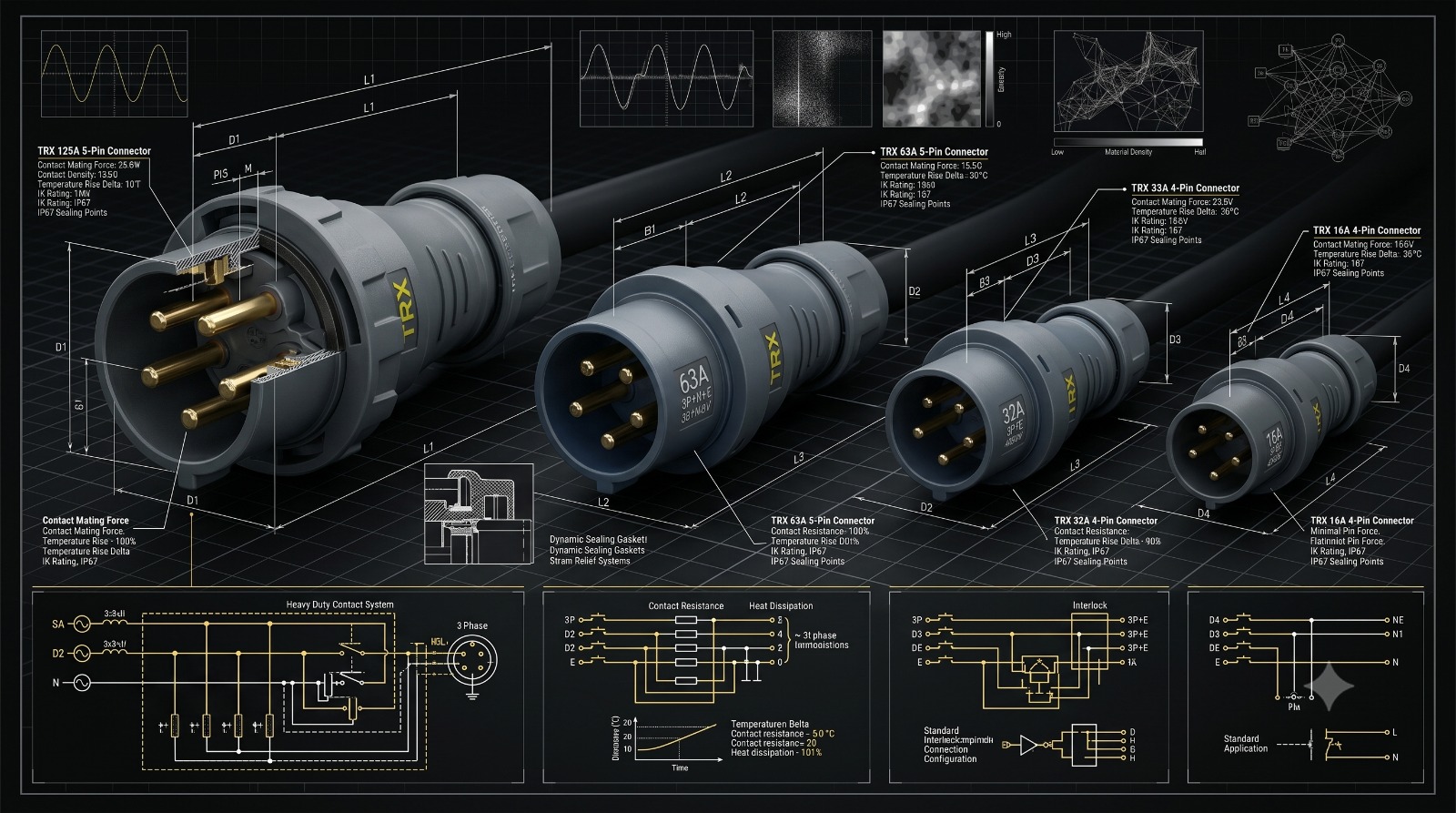
The face seal gasket — typically moulded from EPDM or silicone — creates a compression seal at the mating face when the plug is locked into the socket. The cable entry gland seals the cable entry point and accommodates a range of cable outer diameters without compromising the IP rating. The shutter system — spring-loaded protective plates that cover the socket contacts when the plug is withdrawn — prevents water ingress at the face of the socket even when it is unoccupied. All three elements must function correctly and be inspected regularly to maintain the IP rating in service.
Side-by-Side Comparison
| Feature | IP44 | IP67 | IP69K |
|---|---|---|---|
| Dust protection | Objects >1 mm | Fully dust-tight | Fully dust-tight |
| Water protection | Splashing (any direction) | 1 m immersion / 30 min | 80–100 bar, 80°C jet |
| Direct rain exposure | Sheltered only | Yes | Yes |
| Pressure washing | No | No | Yes (up to 100 bar) |
| Food / pharma washdown | No | Limited | Yes |
TRX Range by IP Class
TRX manufactures IEC 60309 connectors in both IP44 and IP67 protection classes across the complete range of current ratings (16 A, 32 A, 63 A, 125 A) and pole configurations (2P+E, 3P+E, 3P+N+E). The IP67 range uses a triple-seal system with EPDM face gaskets, IP-rated cable glands and automatic spring-loaded shutters, and is tested to IEC 60529 by IMQ.

Installation Checklist
Verify IP Rating Before Installation
Check the product label against the installation environment assessment. Do not rely on supplier description alone — verify against the IEC 60529 classification.
Inspect Cable Gland Selection
The IP rating of the connector assembly is only maintained if the cable gland is correctly sized for the cable outer diameter. Use the gland manufacturer’s specification table.
Annual Gasket Inspection
IP seals degrade with UV exposure, chemical contact and mechanical wear. Inspect face gaskets annually and replace immediately if cracking, compression set or deformation is observed.
Test Shutter Operation
On IP67 sockets, verify the shutter mechanism operates freely and springs shut completely when the plug is withdrawn. Faulty shutters allow direct water ingress to the contact area.