
9 min read
TRX Editorial Team
Why Outdoor Is Different
Indoor industrial electrical installations operate in a largely controlled environment — temperature is relatively stable, contamination is manageable, and maintenance access is straightforward. Outdoor installations face a fundamentally different set of challenges: wide temperature cycling, solar UV radiation, rain, frost, wind-driven particulates, chemical exposure and biological growth, all operating simultaneously over an asset life that may span two or three decades.
Products and installation methods adequate for indoor use will often fail rapidly in outdoor environments. The selection of connectors, enclosures, cable management systems and fixings must be made with the worst-case outdoor conditions in mind — not average conditions. A connector that performs adequately in summer sunshine may fail during the first winter storm if the specification was not properly considered.
Threat Matrix for Outdoor Installations
| Threat | Primary Damage Mechanism | Mitigation |
|---|---|---|
| Rain and flooding | Water ingress to contact area, corrosion, arc tracking | IP67 minimum; drip loops on cables; elevated mounting |
| Solar UV radiation | Polymer degradation, embrittlement, seal cracking | UV-stabilised PA/PP bodies; replace seals per schedule |
| Thermal cycling | Differential expansion loosening contacts and seals | Verify rated temperature range; use flexible cable |
| Dust and airborne particles | Contact contamination, tracking over insulator surfaces | IP6X (dust-tight); periodic contact cleaning |
| Chemical exposure | Polymer attack, accelerated gasket degradation | Specify chemical-resistant materials; consult TRX |
IEC 60309 Products for Outdoor Use
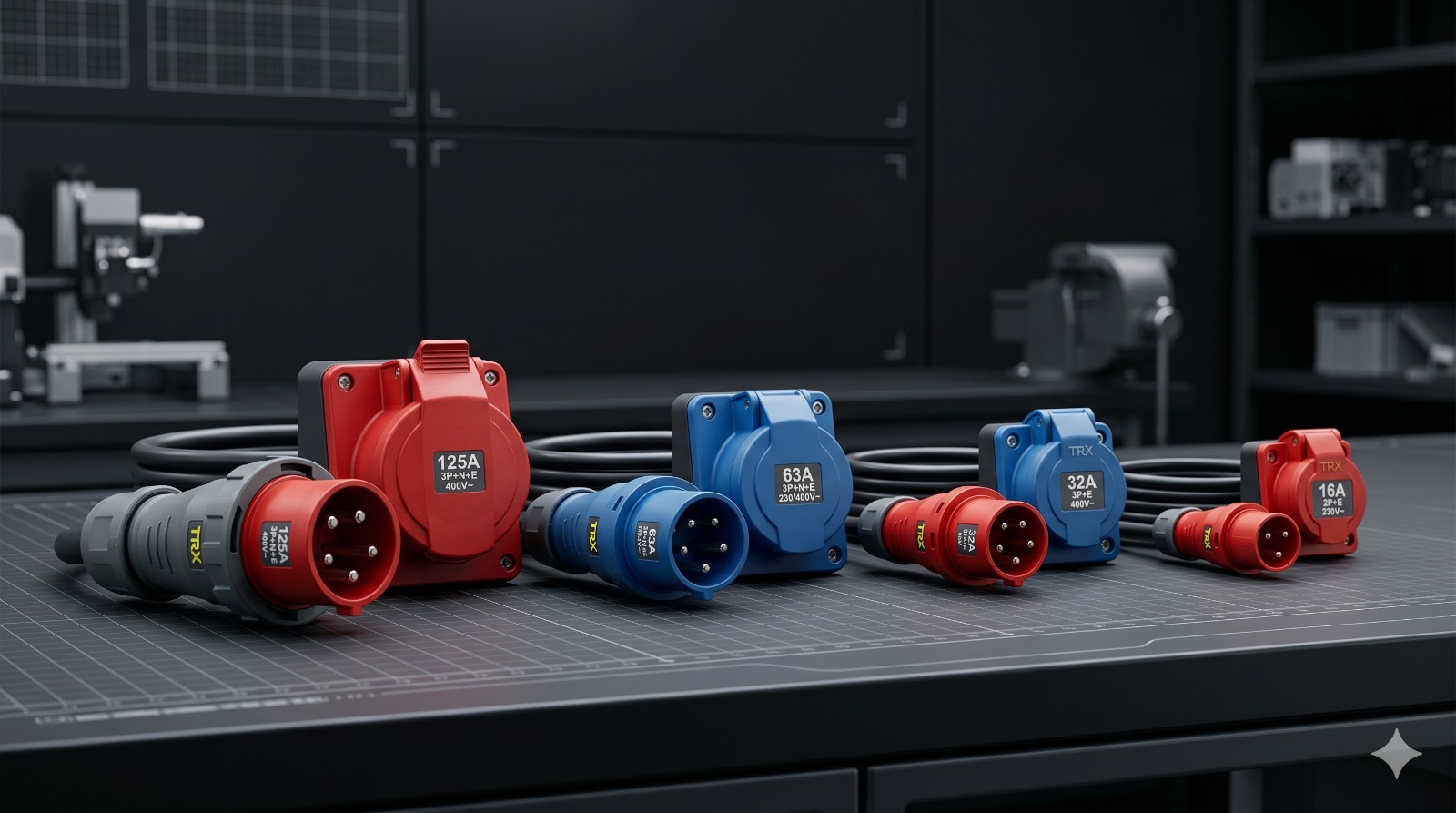
For outdoor IEC 60309 applications, IP67-rated products are the recommended starting specification. The TRX IP67 range covers plugs, socket-outlets (both surface-mounting and panel-mounting), couplers and extension units in all standard pole configurations and current ratings. Key features for outdoor durability include UV-stabilised polyamide body materials rated to UV category F per IEC 60068-2-5, EPDM face gaskets tested across the -25°C to +70°C operating range, and contact bodies of high-tin-bronze alloy to resist corrosion in salt-air environments.
For installations in coastal locations or areas with elevated sulphur content in the atmosphere, specify the TRX coastal-duty version with Ni-plated contact bodies and stainless steel locking ring hardware. For installations where periodic flooding is possible — riverbank sites, temporary event infrastructure, port areas — consider IP68-rated versions tested to depths greater than 1 metre, available on request.
Case Study: The Solar Farm Power Infrastructure
Solar photovoltaic installations represent one of the most demanding outdoor electrical environments. Connectors and enclosures must withstand continuous UV exposure for 25+ years, temperature excursions from -20°C in winter to +60°C at panel surface level in summer, wind-driven rain and dust, and occasional flooding of ground-level cable routes — all while remaining accessible for periodic maintenance under live-circuit conditions.

A representative large-scale solar installation spanning 50 MW across 120 hectares recently specified TRX IP67 63 A 3P+N+E socket-outlets at each inverter station to allow maintenance vehicles to connect portable equipment without shutting down the AC distribution system. The installation used TRX concrete-mount pedestals with integrated IP67 panel-mount sockets, cable entry ducting with IP67 glands, and stainless steel hardware throughout. Five years post-commissioning, no seal or contact replacements have been required.
Cable Management for Outdoor Installations
The cable assembly is the most vulnerable element of any outdoor electrical installation — and the one most frequently under-specified. For outdoor use, cables must carry the H07RN-F or H07BQ-F designation minimum, confirming resistance to oil, ozone and UV. In direct burial applications, SWA (steel wire armoured) or LSZH-sheathed flex with appropriate duct protection is required.
Cable drip loops must be formed wherever cables enter upward-facing sockets or enclosures — a drip loop is a downward loop in the cable immediately below the connector entry point that ensures rainwater running along the cable surface drips off before reaching the connector rather than tracking into it. This simple technique eliminates one of the most common causes of outdoor connector failure.
Maintenance Protocol
Outdoor IEC 60309 installations should be maintained on a schedule that accounts for the installation environment. In a relatively clean rural or coastal environment, an annual inspection cycle is typically adequate. In high-pollution urban or industrial environments, inspection should occur every six months. In food processing, agricultural or chemical industry applications, quarterly inspection is recommended.
Each inspection should cover: physical condition of plug and socket bodies for cracks and impact damage; condition of face gaskets for compression set, cracking or delamination; operation of shutter mechanism; tightness of cable gland; evidence of water or condensation ingress at the contact face; contact resistance measurement at 32 A and 63 A ratings using a calibrated contact resistance meter; and torque check of mounting fixings.
Common Installation Errors Checklist
No Drip Loop Formed
Rainwater runs along the cable directly into the connector body. Form a downward loop minimum 150 mm below the entry point.
Wrong Cable Gland Size
An oversized gland will not compress adequately on the cable, voiding the IP rating at the entry point. Always use the cable manufacturer’s specified outer diameter.
IP44 Used in Rain-Exposed Location
IP44 is tested against splashing water — not sustained rain, ponding or wind-driven precipitation. Always use IP67 for exposed outdoor locations.
Non-UV-Stabilised Cable
Standard PVC cable sheath degrades and cracks under UV exposure within 3–5 years. Specify H07RN-F or UV-stabilised LSZH cable for outdoor installations.