10 min read
TRX Editorial Team
What is IEC 60309?
IEC 60309 (also published as EN 60309 in Europe and BS 4343 in the United Kingdom) is the international standard that defines the design, performance and interchangeability requirements for plugs, socket-outlets, vehicle connectors and couplers intended for industrial use. Published by the International Electrotechnical Commission and adopted across more than 60 countries, IEC 60309 creates a universal language for industrial power connections — ensuring that a plug manufactured in Germany will mate correctly with a socket installed in Brazil, Australia or Japan.
The standard covers AC voltages up to 1000 V, DC voltages up to 1500 V, and current ratings from 16 A through to 800 A. It specifies the physical dimensions, contact arrangements, locking mechanisms, ingress-protection classes and colour-coding system that uniquely identify each product variant. For anyone specifying, installing or procuring industrial electrical equipment, a thorough understanding of IEC 60309 is not optional — it is fundamental.
Current Ratings: 16 A, 32 A, 63 A and 125 A
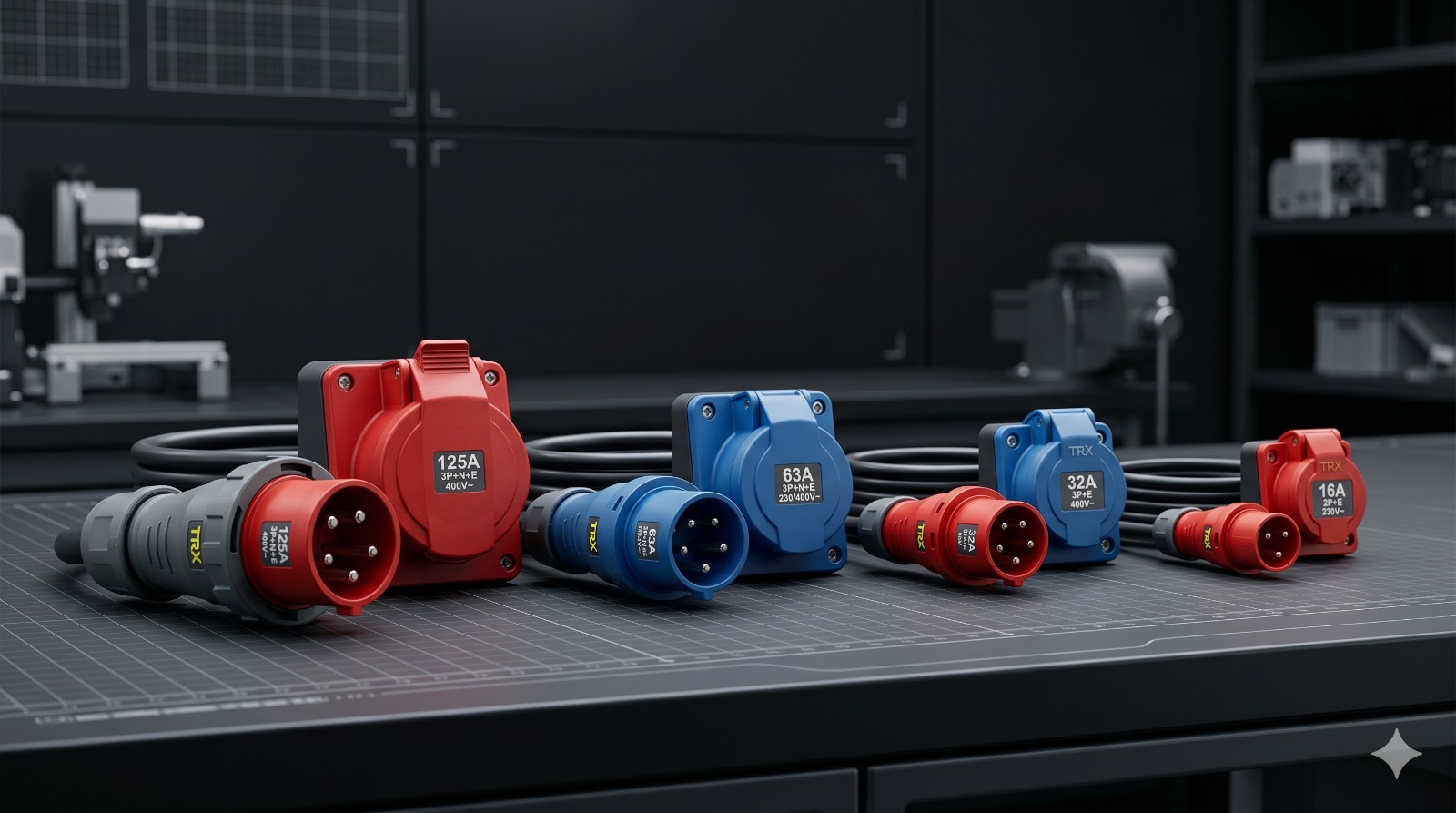
IEC 60309 defines four principal current ratings that cover virtually every industrial application from portable power tools to large industrial process equipment. Each rating step corresponds to a distinct pin diameter and contact spacing, making it physically impossible to plug a 63 A device into a 16 A socket — a crucial safety feature that prevents overloading downstream wiring.
| Current Rating | Typical Application | Pin Diameter (P+E) | Max Cable Cross-Section |
|---|---|---|---|
| 16 A | Power tools, site lighting, small compressors | 4 mm | 2.5 mm² |
| 32 A | Welding equipment, pumps, HVAC units | 6 mm | 6 mm² |
| 63 A | Industrial motors, generator sets, large compressors | 9 mm | 16 mm² |
| 125 A | Heavy plant, substations, temporary power distribution | 12 mm | 35 mm² |
The IEC 60309 Colour Coding System
One of IEC 60309’s most important contributions to electrical safety is its mandatory colour-coding system. Each colour uniquely identifies the voltage and frequency of the circuit, allowing installers and operators to identify the correct socket at a glance — even in low-light conditions or when working under time pressure. Incorrect voltage connections are a leading cause of equipment damage and electrical fires; the colour system is the primary barrier against this class of error.
Yellow
110 V / 50–60 Hz — Used on construction sites under reduced low-voltage (RLV) safety systems. Mandatory in many UK construction environments.
Blue
230 V / 50–60 Hz — The standard single-phase industrial voltage throughout Europe. Most common colour in general industrial use.
Red
400 V / 50–60 Hz — Three-phase power distribution. Used for motors, compressors, welding sets and high-power industrial loads.
Black / White
500–1000 V AC or DC up to 1500 V. Used in specialist heavy industrial and offshore applications.
Pole Configurations: 2P+E, 3P+E and 3P+N+E
IEC 60309 specifies multiple pole configurations to serve every industrial power distribution requirement. The pole count and arrangement are encoded in the physical keying position of the earth pin — a rotation-based coding system that prevents cross-connection between incompatible systems.
2P+E (2 poles + earth): Single-phase supply with protective earth. Used for all standard single-phase industrial loads including power tools, site lighting, battery chargers and portable appliances. The most commonly encountered configuration in European industrial settings.
3P+E (3 poles + earth): Three-phase supply without neutral. Used for balanced three-phase loads — primarily three-phase motors, frequency inverters and three-phase heating elements where no neutral connection is required. The red 400 V variant is by far the most common.
3P+N+E (3 poles + neutral + earth): Three-phase supply with neutral. Required when the load includes single-phase elements fed from a three-phase system — for example, distribution boards, temporary power panels, and mixed-load generator outputs.
IP Protection Levels Under IEC 60309
IEC 60309 products are available in multiple ingress protection classes defined by IEC 60529. The correct IP rating must be selected based on the installation environment — using an IP44-rated connector in a high-pressure wash-down area, for example, creates a genuine risk of arc flash and equipment failure.
IP44 is the minimum rating for most industrial outdoor use — it provides protection against solid objects greater than 1 mm and against water splashing from any direction. IP67 adds full dust-tightness and temporary immersion protection to 1 metre for 30 minutes, making it suitable for washdown areas, food processing plants and outdoor weather-exposed locations. IP69K is the highest rating, tested with high-pressure, high-temperature jets at close range — the standard required in dairy processing, pharmaceutical manufacturing and heavy vehicle wash facilities.
Application Sectors
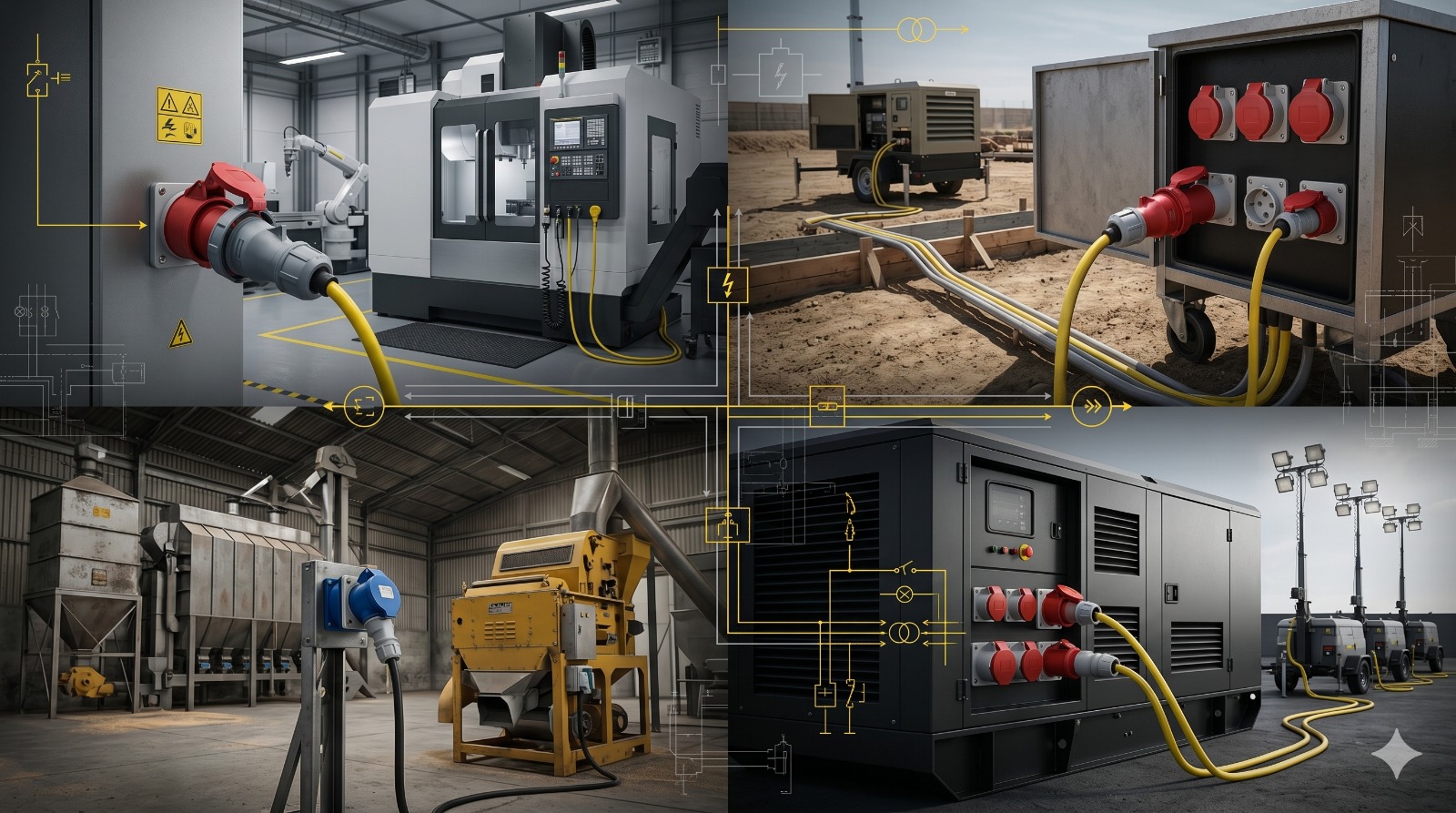
IEC 60309 products are specified across virtually every sector that uses electrical power at an industrial scale. Understanding which sectors have particular requirements helps engineers select not only the correct current rating and pole configuration, but also the appropriate IP class, material specification and installation method.

Manufacturing & Factories
Fixed and mobile machine connections, production line power rails, maintenance drop sockets. IP44 minimum; IP67 in washdown zones.
Construction Sites
Temporary power distribution, tool sockets, tower crane supply. Yellow 110 V for RLV; blue 230 V and red 400 V for heavier plant.
Agriculture & Food Processing
Irrigation pumps, grain handling, refrigeration systems. High-humidity and chemical-wash environments demand IP67 or IP69K.
Events & Temporary Power
Generator outputs, stage power, outdoor festivals. IP44 minimum; robust locking essential where connectors are repeatedly plugged and unplugged.
Certification and CE Marking
All IEC 60309 products placed on the European market must carry CE marking in accordance with the Low Voltage Directive (2014/35/EU) and, where applicable, the ATEX Directive (2014/34/EU) for use in explosive atmospheres. CE marking confirms that the product has been designed, tested and manufactured to meet the essential health and safety requirements of the applicable EU directives.
Third-party certification from accredited bodies such as IMQ, VDE, KEMA or BSI provides an additional layer of assurance beyond self-declaration. TRX products carry IMQ certification and are manufactured to ISO 9001:2015 quality management standards at our Italian facility. All products are subject to 100% electrical testing before dispatch.
When procuring IEC 60309 products, always request the Declaration of Conformity (DoC) and test reports. Be wary of uncertified products sold at significant discounts — sub-standard connectors frequently fail IP testing after minimal field exposure and present serious arc flash risks at higher current ratings.
Frequently Asked Questions
Can I use a 32 A plug in a 16 A socket?
No. IEC 60309 products are designed with incompatible pin diameters between current ratings — a 32 A plug will not physically fit a 16 A socket. This is a deliberate safety feature of the standard.
Are IEC 60309 and CEE connectors the same thing?
“CEE” is a colloquial trade name widely used in Europe, particularly in Germany and Italy. It refers to the same product family standardised under IEC 60309. The terms are interchangeable in practice.
What is the difference between IP44 and IP67?
IP44 protects against solid objects greater than 1 mm and water splashing from any direction. IP67 is fully dust-tight and withstands immersion to 1 m depth for 30 minutes. For outdoor or washdown environments, IP67 is the recommended minimum.